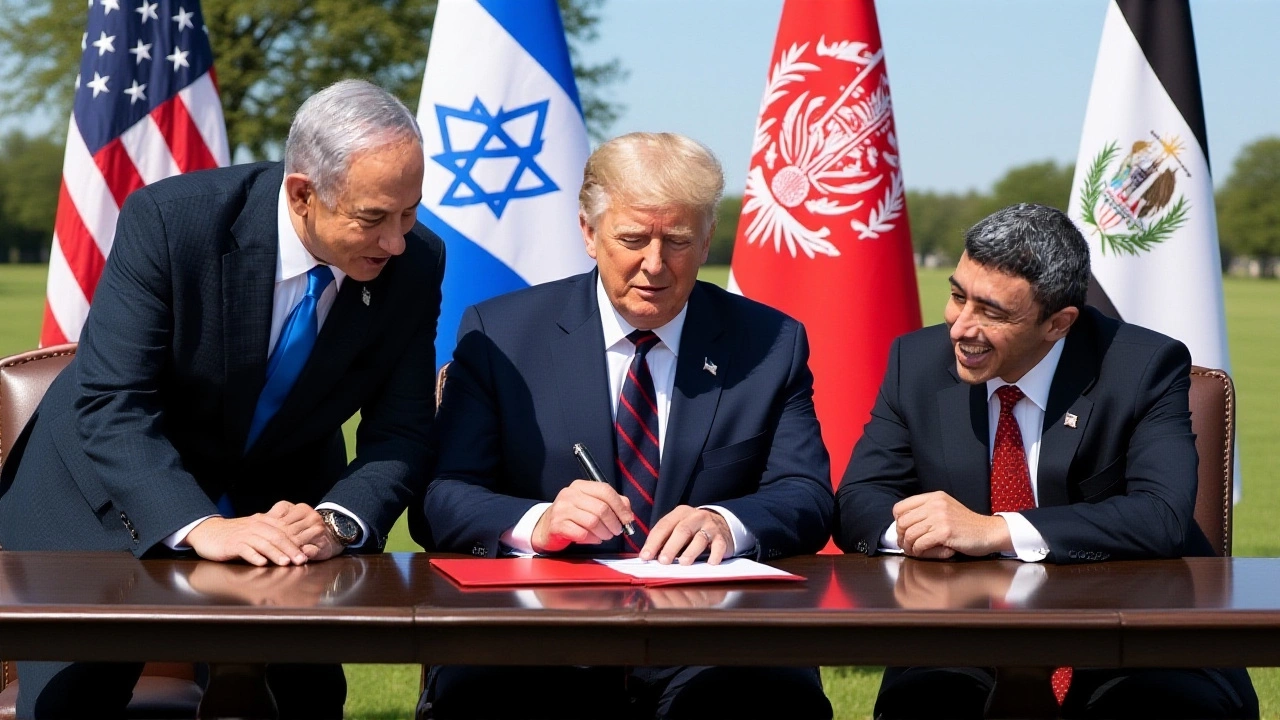
When Mauritania, a small but strategically significant nation in West Africa, signals its intent to join the Abraham Accords, it could mark a seismic shift in Middle Eastern diplomacy. This potential move would make Mauritania the fifth Muslim-majority country to normalize relations with Israel under this framework. The development isn't just another diplomatic footnote; it represents a geographic expansion of the accords from the Middle East into Africa.
The news broke via reports from 'Live Hindustan' and other outlets, citing unnamed sources close to the negotiations. Here's the thing: while no official announcement has been made by Washington or Jerusalem yet, the wheels are clearly turning. A high-level meeting between Mauritanian leaders and Israeli Prime Minister Benjamin Netanyahu is reportedly scheduled on the sidelines of the upcoming U.S.-Africa Leaders Summit at the White House.
A New Geographic Frontier
Turns out, the Abraham Accords aren't staying put in the Levant anymore. Since their inception in 2020, the agreements have primarily involved nations bordering the Mediterranean and the Red Sea. Bringing in Mauritania changes the map entirely. It’s an Arab League member state located on the Atlantic coast of West Africa, thousands of miles from Gaza or the West Bank.
This isn't random. The strategic logic is becoming clearer. By expanding the coalition, proponents argue they are isolating regional adversaries like Iran through economic integration rather than military confrontation. If Mauritania joins, it validates the idea that the "peace dividend"—trade, technology, and security cooperation—is worth more than traditional political solidarity against Israel.
The details are still fuzzy regarding the exact terms. Will there be direct flights? Diplomatic embassies immediately? Or just a framework for future talks? What we do know is that the precedent set here could encourage other African nations to follow suit.
The History Behind the Handshake
To understand why this matters, you have to look back at September 15, 2020. That was the day the original tripartite agreement was signed at the White House. Donald Trump, then President of the United States, brokered the deal between Israel, the United Arab Emirates (UAE), and Bahrain.
It was a shock to many observers who believed the Palestinian issue was the non-negotiable prerequisite for any Arab-Israeli normalization. But the UAE and Bahrain saw opportunity. They wanted access to Israeli tech, deeper security ties with the U.S., and a counterweight to Iranian influence. Morocco joined shortly after in December 2020, followed by Sudan in January 2021.
Interestingly, Kazakhstan also joined the fold in November 2025, though it is not a Muslim-majority nation in the same cultural sense as the others. So when reports say Mauritania would be the "fifth Muslim country," they are referring specifically to the religious demographic alignment, distinguishing it from secular or mixed-signatory states.
Economic Realities vs. Political Rhetoric
Let's talk numbers, because that’s usually what drives these deals. According to recent analysis, trade between Abraham Accord signatories and Israel surged by 127% between 2021 and 2024. That’s not a typo. It’s a massive jump in bilateral commerce involving agriculture, cybersecurity, water management, and finance.
For Mauritania, a developing economy heavily reliant on mining and fishing, the appeal might be different. It’s less about high-tech startups and more about infrastructure investment and security assistance. The U.S. often ties aid packages to diplomatic progress. For a nation facing instability in its southern regions, closer ties with Washington—and by extension, Israel—could mean better intelligence sharing and military support.
But wait, there’s pushback. Critics argue that bypassing the Palestinian question undermines decades of Arab consensus. They call it a betrayal of core principles. Yet, history shows that realpolitik often trumps ideology. Egypt and Jordan normalized relations with Israel in the 1970s and 1990s respectively, long before the two-state solution became a mainstream Western talking point. Their economies didn’t collapse; in fact, tourism and peace dividends helped stabilize them.
Trump’s Push for Expansion
You can’t discuss the current momentum without mentioning Donald Trump. Even after leaving office, he remains deeply invested in the legacy of his foreign policy achievements. Recently, on his social media platform Truth Social, Trump urged several major Muslim-majority nations—including Saudi Arabia, Pakistan, Turkey, Qatar, Egypt, and Jordan—to join the Abraham Accords.
He framed it as part of a broader strategy to contain Iran. His message was clear: if you want security guarantees and economic benefits, align with the Abraham Accord framework. While Saudi Arabia has signaled interest in normalization, it insists on tangible steps toward a Palestinian state first. Pakistan and Turkey remain firmly opposed due to domestic political pressures and longstanding anti-Israel stances.
So where does Mauritania fit in? It’s a smaller player, easier to bring on board without the geopolitical baggage of Riyadh or Ankara. Think of it as a test case. If a West African Arab state can join smoothly, it weakens the argument that "all Muslims must stand united against Israel." It fragments the opposition.
What Happens Next?
The immediate next step is the rumored White House meeting. If Mauritanian officials sit down with Netanyahu and senior U.S. diplomats, it will likely involve drafting the specifics of the relationship. Will it include full diplomatic recognition? Consular services? Joint ventures in renewable energy?
We should watch for announcements in the coming weeks. Usually, these deals are announced with fanfare—photo ops, press conferences, and joint statements. But sometimes, they start quietly. A memorandum of understanding (MoU) might precede the formal treaty.
Regardless of the outcome, the ripple effects will be felt across the region. Other African nations may reconsider their positions. The African Union itself might face internal debate over whether to endorse such moves. And in Palestine, the frustration will likely deepen, fueling further unrest.
Frequently Asked Questions
Why is Mauritania considering joining the Abraham Accords?
Mauritania likely sees strategic benefits in normalizing relations with Israel, including potential economic investments, enhanced security cooperation with the United States, and access to technological expertise. As an Arab League member in West Africa, it also gains diplomatic leverage within regional organizations. The move aligns with a broader trend of African nations prioritizing practical economic gains over ideological alignments.
Who are the current members of the Abraham Accords?
The original signatories were Israel, the United Arab Emirates, and Bahrain, who signed in August and September 2020. Morocco joined in December 2020, and Sudan in January 2021. More recently, Kazakhstan joined in November 2025. These countries have established diplomatic missions, opened direct trade routes, and collaborated on various sectors like tech and defense.
Has the U.S. officially confirmed Mauritania's entry?
No, neither the United States nor Israel has issued an official confirmation as of now. Reports suggest that discussions are ongoing and a key meeting is planned on the sidelines of the U.S.-Africa Leaders Summit. Until a formal statement or signing ceremony occurs, Mauritania's participation remains a strong possibility rather than a finalized fact.
How does this affect the Palestinian cause?
Critics argue that each new normalization deal marginalizes the Palestinian issue by showing that Arab and Muslim states can benefit from ties with Israel without resolving the conflict. Supporters counter that increased regional stability and prosperity eventually create conditions favorable to peace. However, Palestinians view these moves as betrayals that undermine their right to self-determination.
What role did Donald Trump play in this initiative?
Donald Trump spearheaded the Abraham Accords during his presidency, brokering the initial deals between Israel, the UAE, and Bahrain. He continues to advocate for its expansion, recently urging countries like Saudi Arabia, Pakistan, and Turkey to join. He views the accords as one of his major foreign policy successes and a tool to counter Iranian influence in the Middle East.